When the Moon Gave the Stars Back Their Stage
A Night Beneath the Lunar Eclipse on Lake Michigan
There are nights we photograph.
And then there are nights we carry with us.
Last night was one of those nights.
At nine o’clock, we were standing on what felt like a miniature island in the middle of another world. Lake Michigan surrounded us, stretching toward every horizon, while one lonely lighthouse stood against a pale blue evening sky.
The moon was extraordinarily bright.
For a while, it seemed almost impossible to imagine that anything could dim that light.
The island was deserted. There were no crowds around us, no city noise, no distractions. Just my family, the lighthouse, the enormous lake, and the moon rising above it all.
And then the clouds began to arrive.
At first there were only a few. But as time slowly advanced, more and more came rushing across the sky toward the moon, as though suddenly every cloud over Lake Michigan wanted to touch her.
I watched them race through my viewfinder.
Sometimes the moon disappeared completely.
Then, for a few precious seconds, she would break through again, revealing a little more of her slowly fading face.
I kept taking photographs.
Every opening.
Every disappearance.
Every brief return.
Photography teaches you patience on nights like this. You cannot command the sky. You cannot move the clouds or ask the moon to wait. All you can do is remain present and be ready when nature decides to reveal something.
And slowly, almost imperceptibly at first, the entire night began to change.
As the moonlight faded, the clouds seemed to lose their urgency. Fewer of them raced across the sky.
And stars began shimmering above our heads.
One.
Then another.
Then hundreds.
And suddenly, it was as though someone had turned on a switch.
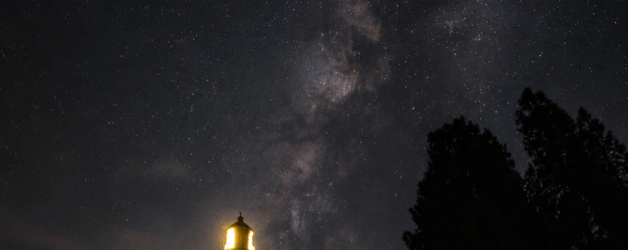
The Milky Way appeared around us.
It stretched across the darkness like a celestial glory surrounding the moon during her spectacular performance.
I stood there in awe.
Not the kind of awe that requires words, but the childlike wonder that makes you feel incredibly small and, somehow, deeply connected to everything at the same time.
At the peak of the eclipse, I stopped for a moment.
I opened my heart and my mind.
And beneath that enormous universe, I quietly asked our Creator for something very simple.
For gentleness.
For less tension between brothers and sisters.
For deeper love for ourselves, so perhaps we can become more understanding of one another.
For the ability to look at another human being with a little more patience, compassion and grace.
Standing beneath the Milky Way with the darkened moon above Lake Michigan, I felt for a moment as though my soul belonged to something much larger than myself.
And more than anything, I felt grateful.
Grateful that my family was beside me.
Grateful that we were witnessing this together.
Grateful simply to be there.
My thoughts also traveled backward through time.
Long before cameras, astronomy apps and eclipse predictions, other human beings stood beneath this same sky.
I wondered about the Native peoples who lived along these waters generations ago.
What did they think when the moon suddenly began disappearing?
Were they frightened?
Did they understand that it would return?
Did parents gather their children close and tell them stories about what was happening above them?
Did they turn celestial events into songs?
Were those songs passed from grandparents to grandchildren so the next generation would remember the night the moon changed?
I will never know exactly what someone standing beside Lake Michigan hundreds or thousands of years ago felt during an eclipse.
But I understand the instinct to tell the story.
Because that instinct is still alive in me.
I live for moments like this.
To bear witness.
To stand quietly before something extraordinary and then try to translate what I saw—and what I felt—into photographs.
The camera records light.
But I hope the photograph can carry something more.
Wonder.
Silence.
Connection.
Memory.
Today we are driving toward the Port Clinton Art Festival, and my mind is already returning to that tiny island.
I am already imagining these photographs printed large, hanging on a wall.
I can see the lighthouse.
The racing clouds.
The disappearing moon.
The Milky Way emerging from a sky that only moments earlier seemed empty of stars.
And beside those photographs, there will need to be a story.
The story of a night when the moon was so brilliant that the stars seemed to disappear beneath her light.
And then, for one extraordinary moment, the moon stepped quietly into the shadows…
and gave the stage back to the stars.
Yet somehow, even surrounded by the brilliance of the Milky Way, all eyes were still on her.
What a night.
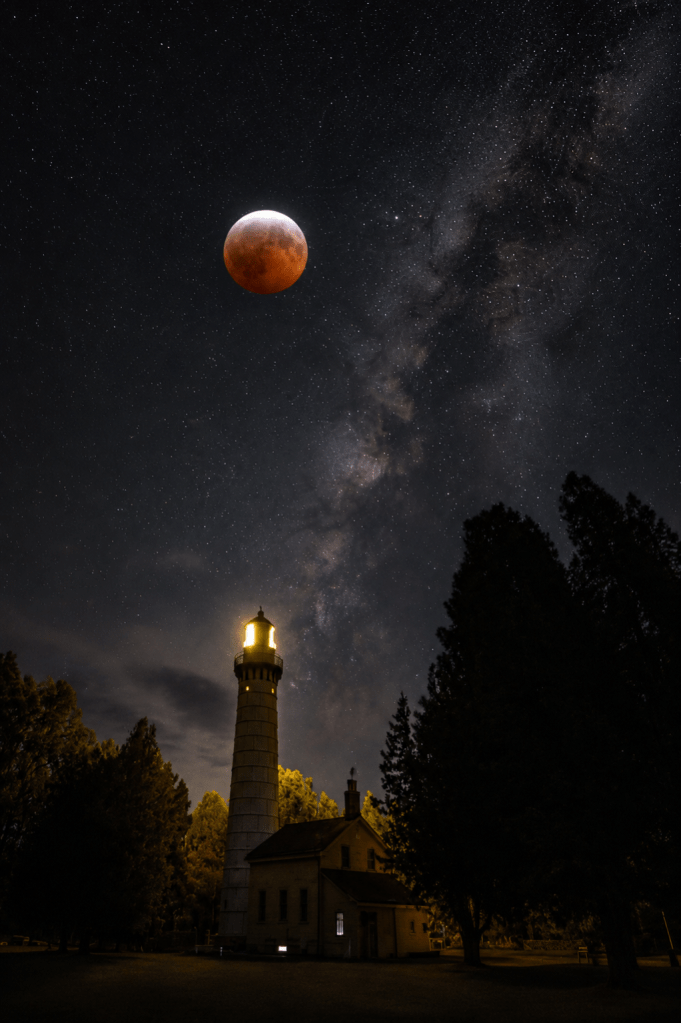
For one extraordinary moment, the eclipsed moon surrendered her brilliant light, and the Milky Way reclaimed the sky above the lonely lighthouse—yet all eyes were still on her.


