Posts tagged ‘#NatureConnection’
When Silence Disappears from the Wild
There are places in America where people still go to remember who they are.
Not shopping centers.
Not crowded attractions.
Not glowing screens demanding our attention every second of the day.
But forests. Marshes. Riverbanks. Desert trails. Places where the wind moves through pine trees like a prayer and the stars still feel close enough to touch.
For many people, nature is not simply recreation. It is restoration.
It is church.
That is why the recent decision to loosen hunting restrictions across dozens of National Park Service sites has struck such a deep emotional chord across the country.
In January, Interior Secretary Doug Burgum signed an order encouraging federal land managers to remove or justify restrictions on hunting and fishing across numerous federally managed lands. The changes affect various National Park Service units where hunting was already permitted in some form — including recreation areas, preserves, and seashores.
Supporters argue these changes expand access and preserve traditional outdoor activities. Critics worry they erode long-standing safety protections and fundamentally change the experience of public lands that belong to everyone.
And many Americans are asking a simple question:
What happens when the places we once escaped to for peace begin to feel unsafe?
At Lake Meredith in Texas, reports indicate hunters may now be permitted to process game in public restrooms. At Cape Cod National Seashore, hunting seasons may expand further into spring and summer. At other sites, restrictions on tree stands, retrieval vehicles, hunting dogs, and proximity to trails have been loosened or reconsidered.
These are not imaginary fears. They are real policy shifts.
But this conversation is about more than regulations.
It is about values.
For decades, America’s public lands represented something rare in modern life: common ground. Places where a child could hear owls at dusk. Where exhausted parents could sit beside a river and finally exhale. Where photographers wait in silence for first light over the mountains. Where wildlife still moves according to ancient rhythms untouched by politics and noise.
When we enter these places, we enter with an unspoken agreement:
that wild things deserve space to exist beyond human domination.
Conservation icon Jane Goodall once said:
“You cannot get through a single day without having an impact on the world around you. What you do makes a difference.”
And what we choose to protect — or fail to protect — says everything about who we are becoming.
This debate is often framed as hunters versus non-hunters, but that oversimplifies a deeply emotional issue.
Many ethical hunters care deeply about conservation. In fact, wildlife management and habitat protection in America have long included hunters, biologists, photographers, indigenous communities, scientists, and park advocates alike. Responsible hunting, when carefully regulated, has historically played a role in funding conservation efforts and maintaining ecological balance in some regions.
But even many supporters of hunting recognize that public lands require boundaries.
Safety matters.
Wildlife corridors matter.
Visitor experience matters.
And sacred quiet matters too.
Because nature is increasingly becoming the last refuge from a culture built on exhaustion.
People are burned out. Overstimulated. Lonely. Disconnected from the natural world.
And when someone walks into a national seashore, riverway, or preserve, they are not entering a battlefield between ideology and recreation. They are often entering a deeply personal sanctuary.
A grieving widow walking a trail at sunrise.
A veteran trying to calm PTSD through solitude.
A child seeing a fox in the wild for the first time.
A photographer waiting hours in silence for the moment fog lifts from a marsh.
These experiences are not small things.
They are healing.
Jane Goodall also warned:
“Only if we understand, can we care. Only if we care, will we help. Only if we help shall all be saved.”
Understanding begins with recognizing that public lands are not merely resources to be used. They are living ecosystems. They are classrooms. They are sanctuaries for both humans and wildlife.
And increasingly, they are disappearing.
Across America, untouched spaces shrink year after year beneath roads, subdivisions, noise, extraction, and political pressure. True silence has become rare. Darkness free from artificial light has become rare. Even the experience of hearing birdsong without interruption is becoming rare.
That is why people react so strongly when protections are loosened.
Not because they oppose tradition.
But because they fear losing one more piece of what still feels sacred.
There is also a larger ethical question quietly waiting beneath the headlines:
What kind of relationship do we want with the natural world?
One based primarily on control?
Or one based on coexistence?
The answer matters because future generations will inherit whatever version of nature we leave behind.
Will children grow up seeing wildlife primarily as targets and trophies?
Or as fellow living beings sharing a fragile planet?
Will public lands become louder, more mechanized, and more extractive?
Or will they remain places where people can still encounter awe?
A civilization reveals itself not through the power it holds over nature, but through the restraint it chooses to exercise.
The healthiest societies are not those that consume every wild place available to them.
They are the societies wise enough to leave some places gentler. Quieter. Protected.
Not everything valuable must be conquered to have meaning.
Some things deserve reverence.
And perhaps now, more than ever, we need places where both animals and people can still breathe freely beneath open skies.
Because once silence disappears from the wild, we may discover too late that something inside us disappeared with it.
Florida’s Black Bears in October: A Season of Urgency and Abundance
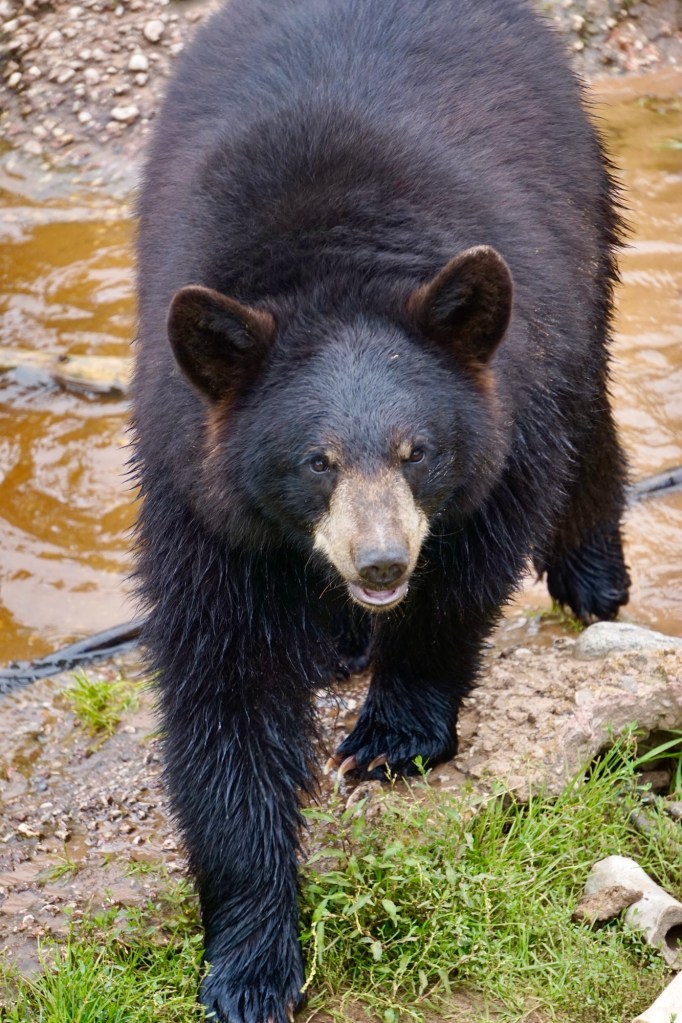
“The golden light of fall catches the sheen of a bear’s coat — a reminder that even in Florida’s warmth, nature prepares for change.”
October in Florida is a month of transition—not only for people trading swimsuits for light jackets, but for the state’s black bears, who enter a season of intense preparation. As the air turns slightly cooler and the daylight shortens, these wild residents of Florida’s forests, hammocks, and swamps shift their focus entirely to one thing: food.
Feeding for the Future
Unlike their northern relatives, Florida black bears don’t face months of deep snow or a long, frozen winter. Still, they instinctively prepare for leaner times by entering a phase called hyperphagia—a biological frenzy of eating. During October, a bear’s day is ruled by its stomach. They spend up to 20 hours foraging, searching tirelessly for high-calorie foods to build fat reserves that will sustain them through the cooler months when natural food becomes scarce.
In Florida’s oak and palmetto forests, acorns become the prized treasure. Bears crunch through the underbrush searching for patches of fallen nuts, sometimes traveling miles between feeding spots. They also feast on saw palmetto berries, wild grapes, beautyberries, and the last persimmons of the season. Opportunistic and highly adaptable, a bear will also dig for grubs, raid anthills, or peel bark for beetle larvae. Every calorie counts.
Solitary Wanderers with Overlapping Paths
Florida black bears are mostly solitary by nature, but during this time, their paths cross more often than usual. When food is abundant, multiple bears may feed in the same area with a quiet tolerance for each other. You can almost sense an unspoken truce—a mutual understanding that October’s bounty won’t last forever.
Mothers with cubs often stay close to reliable feeding zones, teaching their young where to find seasonal foods and how to prepare for the coming months. Young males, on the other hand, begin wandering farther—sometimes covering dozens of miles—to establish their own ranges. This seasonal wandering often brings bears closer to human communities, especially in suburban areas where trash cans and fruit trees mimic easy natural meals.

“Florida’s bears are excellent climbers — they’ll scale trees to escape danger, nap in the canopy, or scout for ripe fruit.”
The Conservation Challenge
For wildlife biologists and conservationists, October is a reminder of how crucial natural food sources are to the bears’ survival. When forests produce good mast crops—especially acorns and palmetto berries—bears stay deep in the woods. But in poor crop years, they’re more likely to follow their noses into neighborhoods. This is when education and coexistence matter most.
Securing garbage, removing bird feeders, and harvesting fruit from backyard trees may seem small, but they’re acts of conservation. Every human choice that keeps bears wild and wary helps preserve not only their safety but also the delicate balance of Florida’s wild spaces.
A Quiet Pause Before Winter
By late October, as the bear’s body grows heavier and their fur thickens, the pace begins to slow. In some northern parts of the state, they’ll retreat to sheltered dens—under fallen logs, in dense thickets, or beneath the roots of old trees. In the subtropics, where winter is mild, many remain active year-round, emerging on warm days to forage or explore. But even there, a calm descends over the forests—a sense that the rush of the season has passed.
Florida’s black bears remind us that even in the heat of the South, the rhythms of nature endure. Their October dance of hunger and preparation is as old as the land itself—a story of resilience, adaptation, and the quiet intelligence of wild creatures who still find a way to thrive in a rapidly changing world.
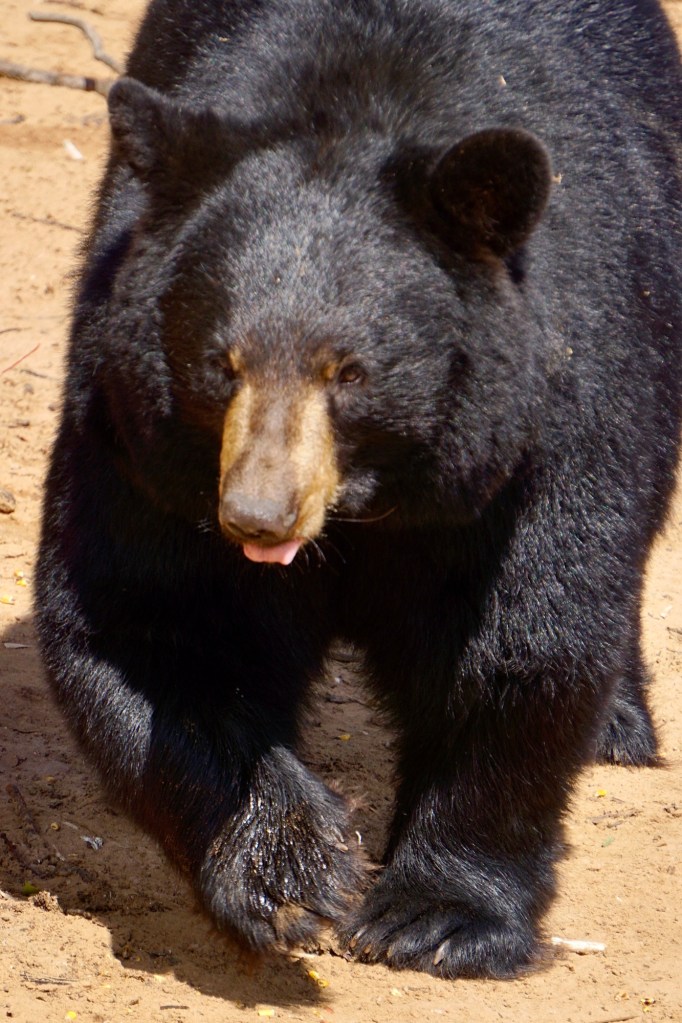
“A Florida black bear on the move — October’s mission: eat, explore, repeat.”
Chasing Stars and Stories: A Door County Night Under the Milky Way
by a Fine Art Conservation Photographer on the Road
Last night felt like a page torn straight from a dream.
Our little traveling trio—Mike, our son, and I—has been weaving a life full of art, nature, and motion. Weekends are spent showcasing my fine art photography at juried festivals, but weekdays? They’re for wonder. We wander, we search, we listen—for places that speak not only to the lens but to the soul. And Door County, Wisconsin, spoke in poetry.
All day, we had biked along winding trails, hiked rugged forest paths, and breathed in the wild air curling off Lake Michigan’s shore. I’d already filled my mind with compositions—fragments of roots, glimmers of water through trees, the play of light on old wood. But nothing prepared me for what the night had in store.
It was Mike’s idea, of course. “Let’s shoot the lighthouse with the Milky Way,” he said. I immediately reached for my PhotoPills app. I had exactly 57 minutes before the moonrise would wash the stars away. It was a race against time and light.
Back to the campground—gear check, layers on. Quick dinner, quicker frozen custard (because… priorities). Then we drove through the twilight to our secret spot, a little spit of land reaching out toward a forgotten island, where the lighthouse stood like a sentinel under the stars.
The air was crisp. The parking lot was silent. Our breath puffed clouds into the inky night. With each step across the narrow land bridge, waves whispered on both sides. The lake breathed in sync with us. The sky stretched endlessly overhead—dark and glittering, as if the universe was watching.
When we arrived, I instinctively knew the spot. The Milky Way curled right over the lighthouse like it had always belonged there. While I set up the panoramic composition, my fingers felt the chill, but my heart raced. Every frame was a story. The long exposure pulled starlight into the sensor like memory being etched into glass.
Then—magic. The moon began its gentle rise, spilling golden light across the lake in a shimmering ribbon. A path of light, just for us. I followed it down the shoreline, capturing reflections, silhouettes, the glowing bridge between earth and sky. Around every corner was another frame I had to make. It was one of those rare nights where nature gave everything, and asked only that you notice.
Eventually, it was time to go. My body ached. My eyes were dry. But I was filled to the brim. I knew morning meant another journey—another festival, another crowd, another long drive. But the light of the stars had already burned themselves into my soul. And the hush of the water? That’s a sound I’ll carry with me always.
This is why we travel. This is why I photograph. To catch those flickering moments when the world reminds us that we belong to it—and not the other way around.
Until the next story under the stars,
✨📸
—Zsuzsanna Luciano
Csillagok és Történetek Nyomában: Egy Éjszaka Door Countyban a Tejút Alatt
Zsuzsanna, fine art conservation photographer
Tegnap este olyan volt, mint egy álomból tépett lap.
Kis utazó triónk—Mike, a fiunk és én—egy művészetben, természetben és mozgásban gazdag életet sző. A hétvégéket a fine art fotográfiám bemutatásával töltjük a válogatott fesztiválokon, de a hétköznapok? Azok a csodáké. Barangolunk, keresünk, hallgatunk—olyan helyeket, amelyek nemcsak a lencsét, hanem a lelket is megszólítják. Door County, Wisconsin, pedig költészetben szólt.
Egész nap kerékpároztunk kanyargós ösvényeken, túráztunk zord erdei utakon, és beszívva a vad levegőt a Michigan-tó partjáról. Már tele volt a fejem kompozíciókkal—gyökerek töredékei, vízcsillanások a fák között, a fény játéka a régi fán. De semmi sem készített fel arra, amit az este tartogatott.
Természetesen Mike ötlete volt. „Fényképezzük le a világítótornyot a Tejút alatt,” mondta. Azonnal elővettem a PhotoPills alkalmazásomat. Pontosan 57 percem volt, mielőtt a holdfelkelte elmosta volna a csillagokat. Versenyfutás volt az idővel és a fénnyel.
Vissza a kempingbe—felszerelés ellenőrzés, rétegek fel. Gyors vacsora, még gyorsabb fagyasztott puding (mert… prioritások). Aztán a twilighton át hajtottunk a titkos helyünkre, egy kis földnyelvre, amely egy elfeledett sziget felé nyújtózott, ahol a világítótorony állt, mint egy őr a csillagok alatt.
A levegő friss volt. A parkoló csendes. A leheletünk felhőket fújt az inkább fekete éjszakába. Minden lépéssel a keskeny földhídon, a hullámok suttogtak mindkét oldalon. A tó lélegzete szinkronban volt a miénkkel. Az ég végtelenül nyúlt fölöttünk—sötét és csillogó, mintha az univerzum figyelne.
Amikor megérkeztünk, ösztönösen tudtam, hogy hol vagyunk. A Tejút éppen a világítótorony fölé kanyarodott, mintha mindig is ott lett volna. Míg beállítottam a panoráma kompozíciót, az ujjaim érezték a hideget, de a szívem dobogott. Minden egyes felvétel egy történet volt. A hosszú expozíció a csillagfényeket a szenzorba vonta, mint egy emlék, ami üvegbe vésődik.
Aztán—varázslat. A hold szelíden emelkedni kezdett, arany fényt öntve a tóra egy csillogó szalag formájában. Egy fényút, csak nekünk. Követtem a part mentén, rögzítve a visszatükröződéseket, sziluetteket, a föld és az ég közötti fénylő hidat. Minden sarkon egy újabb felvétel várt rám. Olyan ritka éjszaka volt ez, ahol a természet mindent adott, és csak azt kérte, hogy vegyük észre.
Végül elérkezett az idő a távozásra. A testem fájt. A szemeim szárazak voltak. De tele voltam. Tudtam, hogy a reggel újabb utat jelent—újabb fesztivált, újabb tömeget, újabb hosszú utat. De a csillagok fénye már belenehezedett a lelkembe. És a víz csöndje? Az egy olyan hang, amit mindig magammal hordozok.
Ezért utazunk. Ezért fényképezem. Hogy elkapjam azokat a pislákoló pillanatokat, amikor a világ emlékeztet arra, hogy hozzá tartozunk—és nem fordítva.
A következő történetig a csillagok alatt,
✨📸
—Zsuzsanna
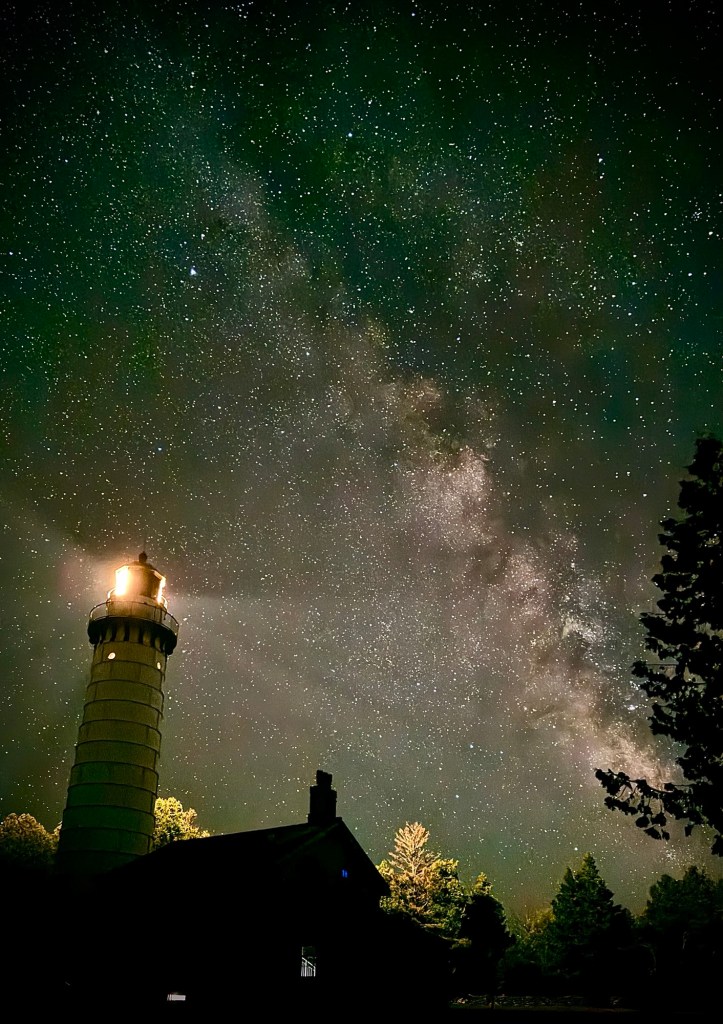
“The lighthouse stood still, cradled by stars, as the Milky Way arched overhead—guiding more than ships, it lit a path straight to the soul.”


