Posts tagged ‘magnetite in humans’
🌌 When the Sky Dances: How the Aurora Borealis Affects the Human Body and Mind
By Zsuzsanna Luciano, Fine Art Conservation Photographer
Last Year, I Lost My Direction Beneath the Northern Lights
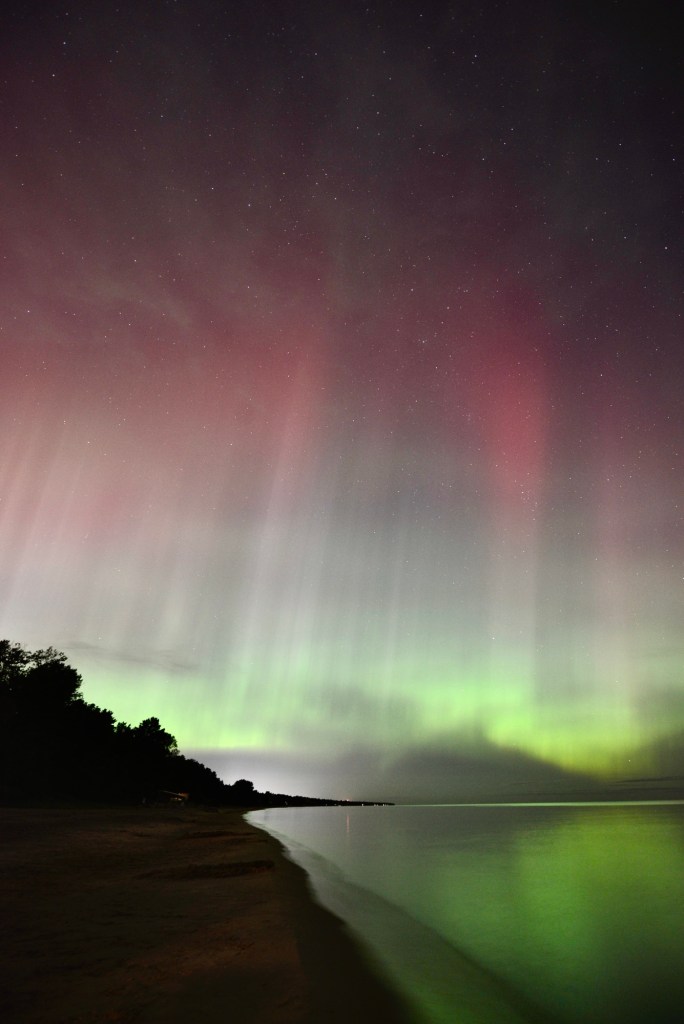
Last fall, I found myself deep in the Wisconsin woods, bundled in wool and fleece, standing under a sky that shimmered like a celestial ocean. The aurora borealis was directly overhead for several hours – green flames twisting into violet ribbons, pulsing and expanding like some living cosmic entity.
I was there to photograph it. But something strange happened.
I lost my sense of direction. Not poetically. Literally. My inner compass—normally sharp from years of navigating wilderness—just shut off. I walked in the wrong direction for nearly an hour one night, convinced I was heading back to our camper.
I felt euphoric, mesmerized, and oddly disconnected from time. And it turns out, I’m not alone.
What Exactly Is the Aurora Borealis?
The aurora is caused by charged particles from the sun colliding with gases in Earth’s atmosphere. These interactions generate breathtaking light displays—commonly green, but also pink, purple, red, and even blue.
It’s more than just pretty lights. The aurora is an electromagnetic phenomenon, affecting Earth’s magnetic field—and possibly us humans, too.
The Surprising Effects on the Human Body
🧭 1. Magnetic Confusion: Your Internal GPS May Malfunction
Did you know your brain contains tiny magnetic particles called magnetite? Like migratory birds, humans may use Earth’s magnetic field for orientation.
When auroral activity is strong, that magnetic field fluctuates—and that might throw off your sense of direction.
When I was under the aurora for multiple nights, I completely lost my bearings. GPS helped, but something inside me wasn’t working the same. It’s both fascinating and a little spooky.
😵💫 2. Dreamy, Euphoric, and a Bit Foggy
Many aurora-watchers report experiencing:
A dreamlike or timeless state Deep emotional surges—tears, awe, peace Cognitive fog, forgetfulness, or mild confusion
Scientists suggest this could be due to:
Melatonin disruption (the light confuses your sleep-wake cycle) Electromagnetic brainwave interaction, which may influence emotion or perception Sleep deprivation and overstimulation from the experience itself
Personally, I felt like I was floating through a lucid dream I didn’t want to wake from. My camera kept me tethered to reality, but barely.
📸 3. The Photographer’s Experience: Art, Exhaustion, and Ecstasy
Photographing the aurora is a unique blend of technical patience and emotional overwhelm. You wait for hours in the dark, monitor cloud cover, adjust your camera with freezing fingers… and then—boom—the sky explodes.
But it takes a toll:
Extreme cold (I’ve shot in -22°F with a camera battery tucked in my bra!) Sleep deprivation (auroras peak between 10 p.m. and 2 a.m.) Isolation and mental strain, especially during multi-night shoots
During one shoot in Iceland, I lived off trail mix and instant coffee for four days, barely sleeping between bursts of light and wonder. I wasn’t tired at the time—but I crashed hard afterward.
Are There Healing Effects of the Aurora?
Some believe auroras have healing properties, particularly in the realm of energy and bioelectromagnetism. While research is still emerging, anecdotal experiences include:
Vivid dreams and increased intuition Enhanced meditative or spiritual states A sense of deep reconnection with nature and the cosmos
📘 Curious? Explore Bioelectromagnetics Journal
Fascinating Aurora Facts
🌍 Other planets have auroras—Jupiter’s are enormous 👂 Some people hear them—a faint crackling or hissing sound 🐾 Animals, including whales and reindeer, react to auroral shifts 📸 You can photograph auroras in real-time with high ISO and a tripod 📱 Use apps like My Aurora Forecast to plan your night
Final Thoughts: When the Lights Find You
The aurora borealis isn’t just something to see—it’s something that happens to you. It changes your rhythm, your senses, even your perception of time and direction.
As a photographer, I live for these moments. But as a human being, I leave changed each time.
So if you ever find yourself under a sky that glows like a living flame, don’t be surprised if you forget where you are—or even who you are—for just a little while. That’s part of the magic.
About Me
I’m a fine art conservation photographer traveling across North America with my husband and son. When I’m not exhibiting at juried art festivals, I chase storms, wildlife, and the mysteries of the natural world. Follow along on IG or join my newsletter for behind-the-scenes stories and new limited edition art drops.


 Luciano Photography