Posts tagged ‘biodiversity’
What We Are Being Told — And What We Still Need to Ask
Today, the City of Dunnellon released an official statement regarding the railroad tie fire.
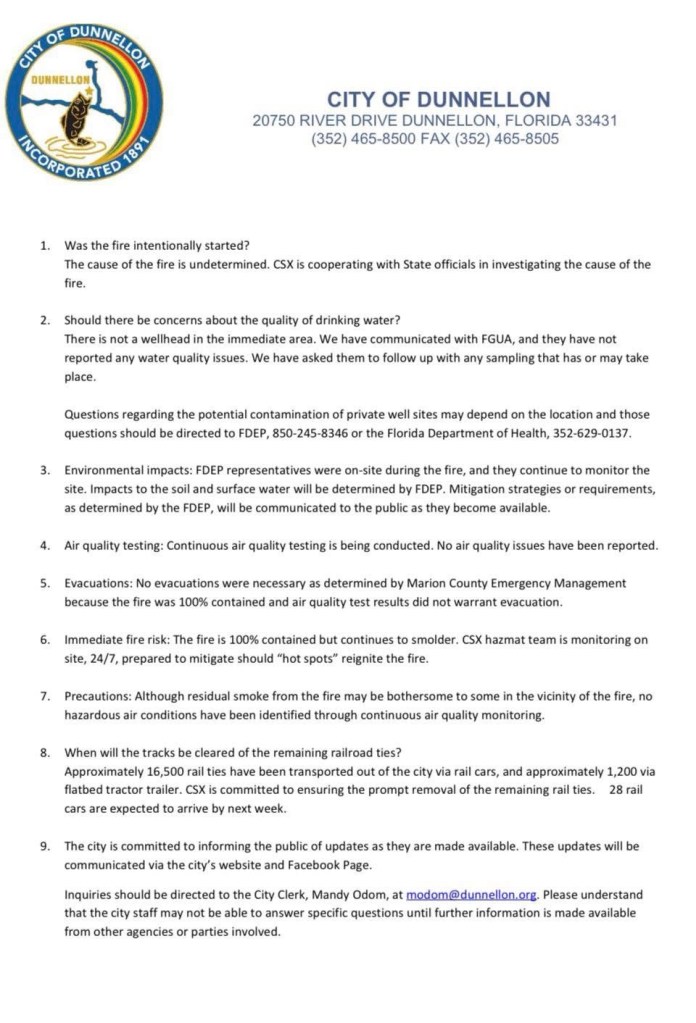
The message is measured. Reassuring in tone. It tells us that the cause of the fire is undetermined, that state agencies were present, that air and water testing have not shown immediate concerns, and that large numbers of railroad ties are in the process of being removed.
This information matters. It should be read carefully.
It also deserves context.
According to the statement:
The fire is contained, though it continues to smolder. Continuous air quality monitoring has not identified hazardous conditions. No immediate drinking water issues have been reported by utilities. Environmental impacts to soil and surface water are still being evaluated. Tens of thousands of treated railroad ties are being transported out of the area. The public will be updated as information becomes available.
These are facts as currently presented.
But environmental stewardship requires us to ask not only what is known today, but also what is not yet known—and who has, or has not, been brought into the conversation.
The Question of Proximity
After reading the statement, I went to Rainbow Springs State Park.
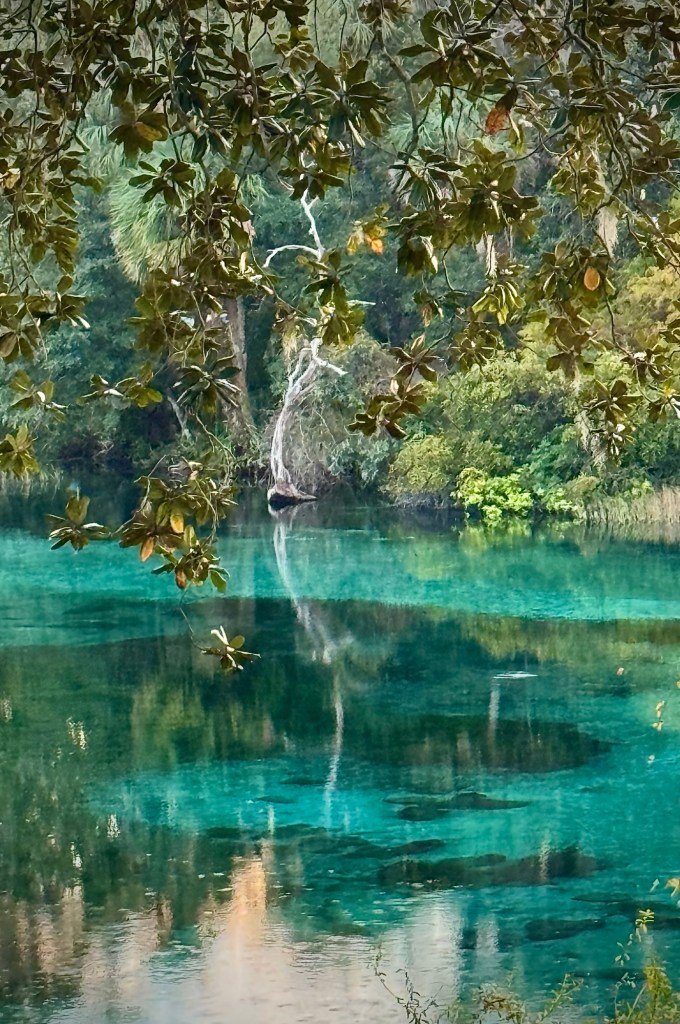
I swam in the head spring.
Before entering the water, I asked a ranger a simple question:
Has anyone contacted the park about the fire next door?
Her answer was just as simple.
No.
No outreach.
No briefing.
No communication.
This is not an accusation. Rangers are not decision-makers. They are stewards of a place that exists to protect water, wildlife, and public trust.
But the absence of communication matters.
Rainbow Springs is not an abstract neighbor. It is hydrologically connected land. It is habitat. It is recreation. It is a window into the aquifer itself.
Water does not wait for press releases.
What Monitoring Can—and Cannot—Tell Us
The statement emphasizes that no air or water quality issues have been identified so far. That distinction is important.
Environmental contamination is often slow, not immediate.
It can take time for compounds to move through soil.
It can take years for patterns to appear in groundwater.
Monitoring tells us what instruments detect at the moment of testing. It does not eliminate the need for transparency, independent verification, and long-term follow-up—especially when the material involved is chemically treated wood designed to resist decay.
This is not fear.
This is how environmental science works.
What Remains on the Ground
The most important line in the statement may be the one that receives the least attention:
the acknowledgment that many railroad ties remain and that removal is ongoing.
That matters because the fire itself was not the only risk.
The stockpile was.
And until the site is fully cleared, stabilized, and assessed—not just for air, but for soil and water pathways—the story is not finished.
Why I Photographed the Springs
I photographed the landscape and water at Rainbow Springs not to suggest contamination, and not to alarm.
I photographed it to remind us what is being protected.
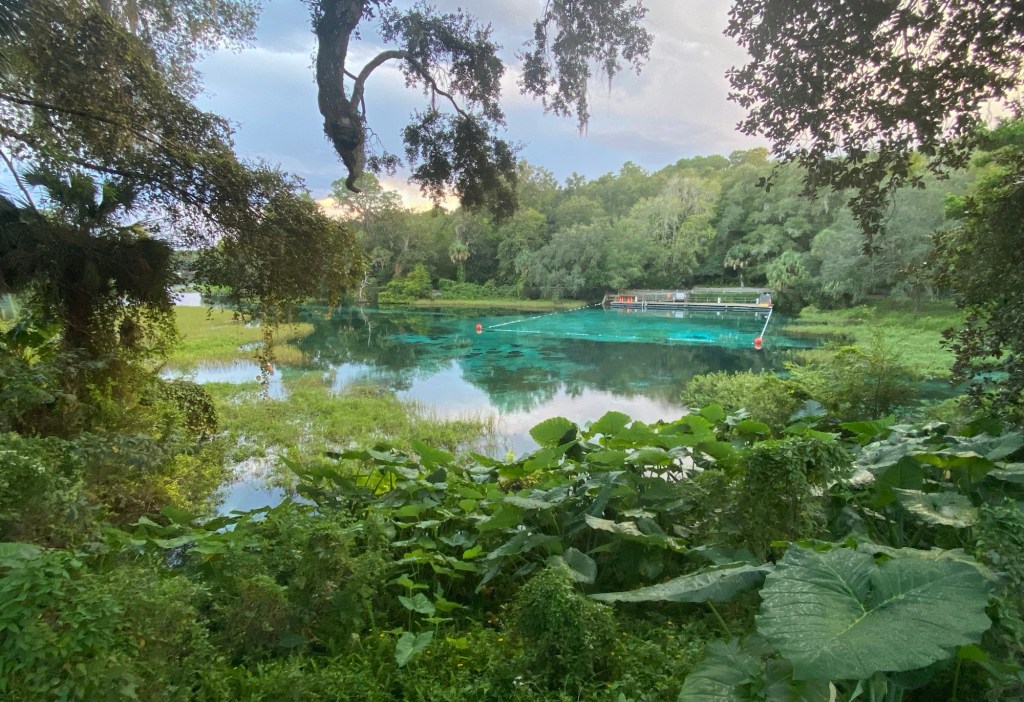
Clear water.
Submerged grasses.
Reflections of forest and sky.
These are not luxuries. They are indicators of ecological health that took centuries to form and could be altered far more quickly than we realize.
Hope begins with attention.
A Call for Connection, Not Conflict
This is not a call for panic.
It is a call for coordination.
State agencies, city officials, utilities, and land managers all have roles to play. Communication between them—and with the public—is not optional when shared resources are involved.
Transparency builds trust.
Silence invites speculation.
The people who live here, swim here, drink this water, and raise families here deserve to be part of the conversation—not after decisions are complete, but while they are being made.
We Are Still Here
I will continue to document what I see.
I will continue to read what is released.
And I will continue to believe that caring, asking, and paying attention are acts of hope—not opposition.
This place matters.
And what we do now will shape how it looks, feels, and sustains life long after the smoke has cleared.
Florida’s Black Bears in October: A Season of Urgency and Abundance
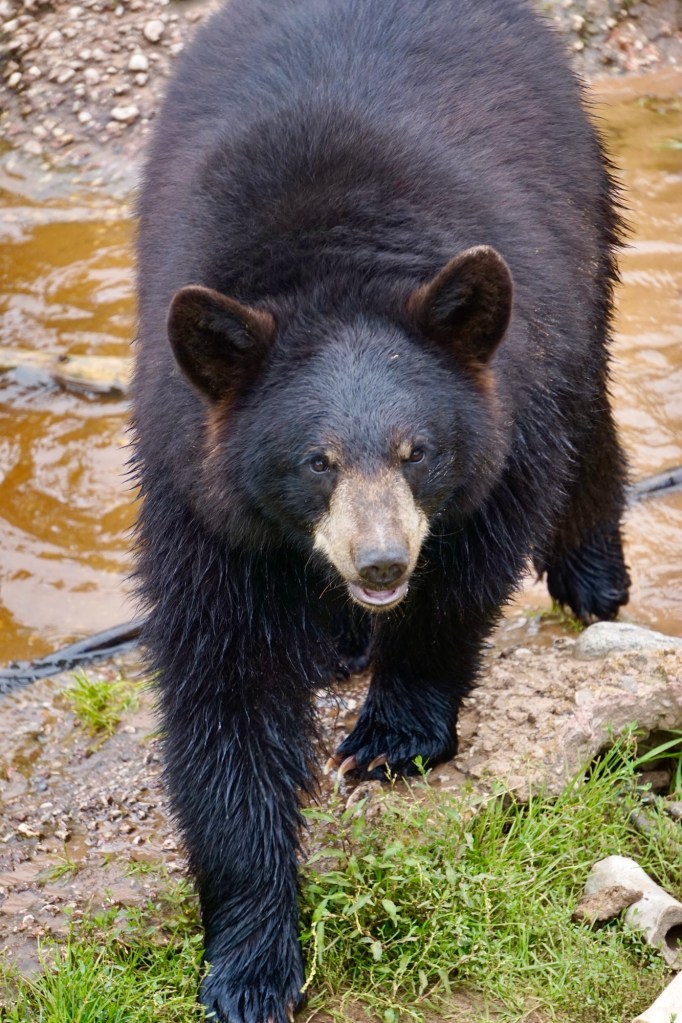
“The golden light of fall catches the sheen of a bear’s coat — a reminder that even in Florida’s warmth, nature prepares for change.”
October in Florida is a month of transition—not only for people trading swimsuits for light jackets, but for the state’s black bears, who enter a season of intense preparation. As the air turns slightly cooler and the daylight shortens, these wild residents of Florida’s forests, hammocks, and swamps shift their focus entirely to one thing: food.
Feeding for the Future
Unlike their northern relatives, Florida black bears don’t face months of deep snow or a long, frozen winter. Still, they instinctively prepare for leaner times by entering a phase called hyperphagia—a biological frenzy of eating. During October, a bear’s day is ruled by its stomach. They spend up to 20 hours foraging, searching tirelessly for high-calorie foods to build fat reserves that will sustain them through the cooler months when natural food becomes scarce.
In Florida’s oak and palmetto forests, acorns become the prized treasure. Bears crunch through the underbrush searching for patches of fallen nuts, sometimes traveling miles between feeding spots. They also feast on saw palmetto berries, wild grapes, beautyberries, and the last persimmons of the season. Opportunistic and highly adaptable, a bear will also dig for grubs, raid anthills, or peel bark for beetle larvae. Every calorie counts.
Solitary Wanderers with Overlapping Paths
Florida black bears are mostly solitary by nature, but during this time, their paths cross more often than usual. When food is abundant, multiple bears may feed in the same area with a quiet tolerance for each other. You can almost sense an unspoken truce—a mutual understanding that October’s bounty won’t last forever.
Mothers with cubs often stay close to reliable feeding zones, teaching their young where to find seasonal foods and how to prepare for the coming months. Young males, on the other hand, begin wandering farther—sometimes covering dozens of miles—to establish their own ranges. This seasonal wandering often brings bears closer to human communities, especially in suburban areas where trash cans and fruit trees mimic easy natural meals.

“Florida’s bears are excellent climbers — they’ll scale trees to escape danger, nap in the canopy, or scout for ripe fruit.”
The Conservation Challenge
For wildlife biologists and conservationists, October is a reminder of how crucial natural food sources are to the bears’ survival. When forests produce good mast crops—especially acorns and palmetto berries—bears stay deep in the woods. But in poor crop years, they’re more likely to follow their noses into neighborhoods. This is when education and coexistence matter most.
Securing garbage, removing bird feeders, and harvesting fruit from backyard trees may seem small, but they’re acts of conservation. Every human choice that keeps bears wild and wary helps preserve not only their safety but also the delicate balance of Florida’s wild spaces.
A Quiet Pause Before Winter
By late October, as the bear’s body grows heavier and their fur thickens, the pace begins to slow. In some northern parts of the state, they’ll retreat to sheltered dens—under fallen logs, in dense thickets, or beneath the roots of old trees. In the subtropics, where winter is mild, many remain active year-round, emerging on warm days to forage or explore. But even there, a calm descends over the forests—a sense that the rush of the season has passed.
Florida’s black bears remind us that even in the heat of the South, the rhythms of nature endure. Their October dance of hunger and preparation is as old as the land itself—a story of resilience, adaptation, and the quiet intelligence of wild creatures who still find a way to thrive in a rapidly changing world.
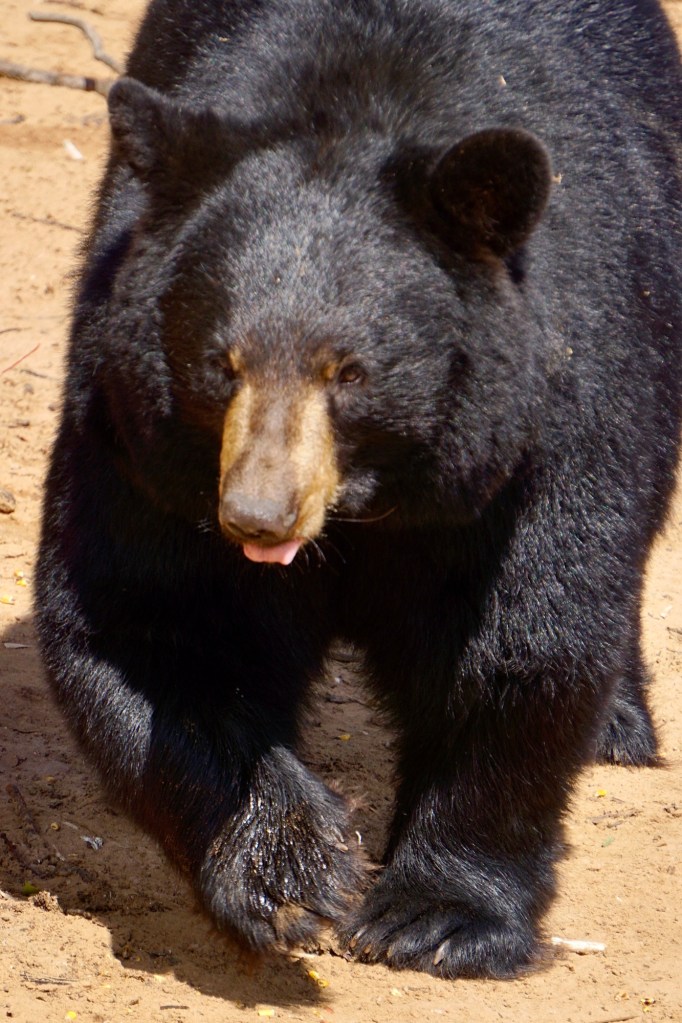
“A Florida black bear on the move — October’s mission: eat, explore, repeat.”
Raising rising conciseness
I love the taste of Nutella… My whole family loves Nutella… My 11 year old son loves Nutella too.
But today he came to understand that our actions have consequences.
So from today he gave up his Nutella, Kinder and KitKat and whatever else has palm oil.
We had a wonderful day at the Tampa Lowry Zoo. He loves to learn about the animals, he starting to understand the difference between vulnerable or critically endangered species.
I thought every monkey was a monkey.
But my son told me that the ones that don’t have a tail are called apes. And the ones with the tail are monkeys.
I know I have a lot to learn😇
I am always taken by the eyes of the orangutans. It’s like they are telling me something or feeling sad…
As we approached the area where these apes are living my eyes got caught on a sign.
…wild orangutans will be extinct by 2020 because of the habitat loss…That is less than three years from now…
Than I looked back at the mother and the baby and the fact that they will never roam free in a rainforest and they will be forever confined to that small area…I started crying. My son cried with me too.
He asked me -“how is palm oil killing these beautiful creatures? Are they eating it?”
I looked at him. He is so innocent…
I told him – “No my love, they aren’t eating the oil. People are cutting down the rainforest that is their habitat and planting palm trees instead to make palm oil.
Palm oil is a very cheap food and cosmetic additive and people and industries are making a lots of money of it.”
– “I will never eating palm oil anymore!” – he told me.
Than we hugged and cried and hugged even more…
As I looked at the baby orangutan I wished I could change the world.
But maybe we can…
…One Nutella at the time…
-Zsuzsanna Luciano-

 Luciano Photography